Operations · Analyst · Work sample: fictional scenario, synthetic data
Review 25 software subscriptions and find $18,601 a year in savings
A 25-tool subscription export reviewed for waste: $18,601 a year in savings and $2,707 in refunds, checked three ways.
Found $18,601 a year in recurring savings against a $12,000 target, plus $2,707 in refunds from three billing errors. Nothing on the peak-season freeze list was touched.
- Time taken
- 90 min (time box)
- Tools
- Excel
- AI used
- Claude
- Skills
- Spend analysis, Billing-error detection, Renewal planning, Reconciliation
- Date
As it arrived
Dana wants us to find at least $12,000 a year in software and subscription savings without hurting peak season. Attached is the Q3 card and invoice export for every subscription, with the seat and usage counts IT pulled last week. Can you send me a one-page recommendation by Tuesday, Oct 20, 12:00 PM ET? Flag anything that looks like a billing error. We may be owed money.
Quick look
Deliverables
The details
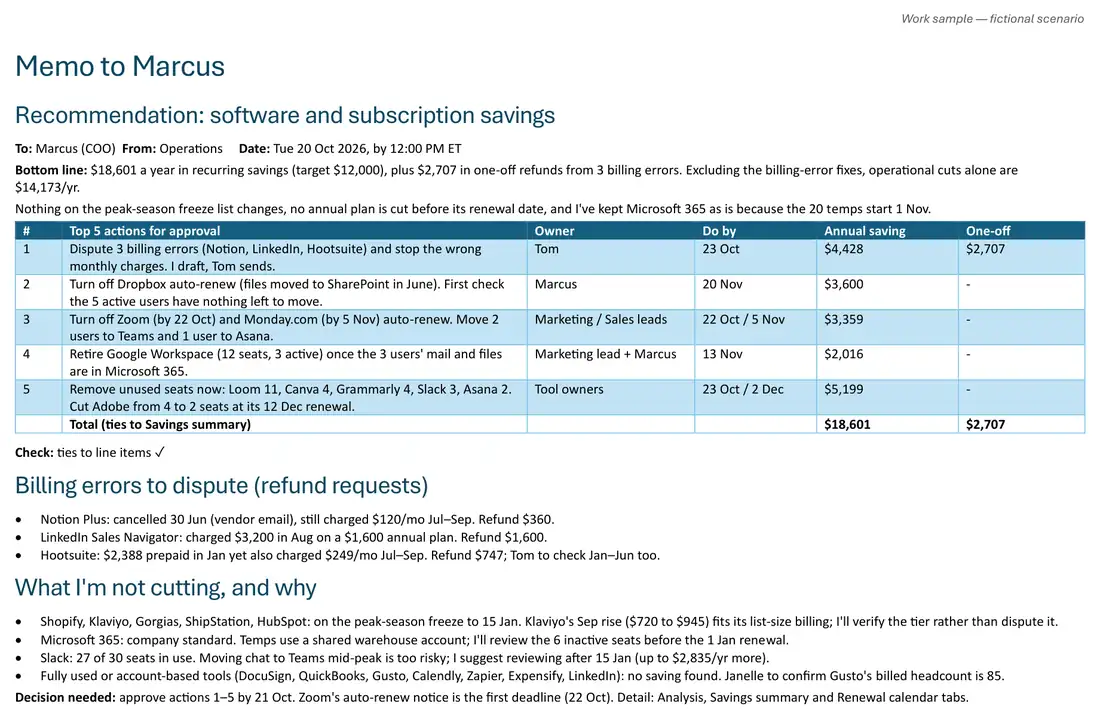
Send Marcus (COO) one page by Tuesday, Oct 20, 12:00 PM ET.
The constraints: no changes to Shopify, Klaviyo, Gorgias, ShipStation or HubSpot before Jan 15, 2027. Seat cuts apply from the next billing date, and annual plans can only be cut at renewal. Billing disputes go to the Controller, who sends them. Vendors are not contacted directly.
My approach
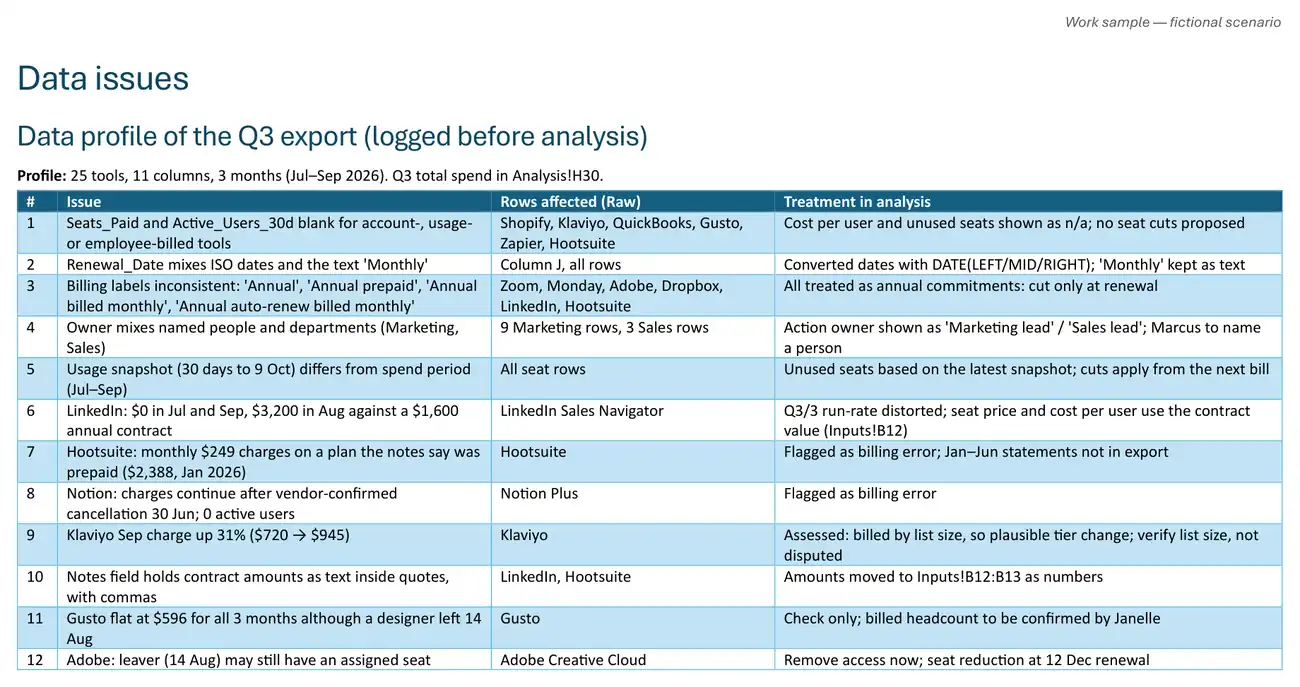
- Profiled the export first and logged 12 data problems before analyzing anything.
- Worked out, for each tool, Q3 spend, monthly run-rate, cost per active user and unused seats. “Active” meant a login in the 30 days to Oct 9.
- Classified every tool as billing error, unused seats, duplicate tool, renewal risk or keep.
- Checked each cut against the peak-season freeze, the renewal dates and the 20 temps who start on Nov 1.
- Annualized every saving, and showed the calculation next to it.
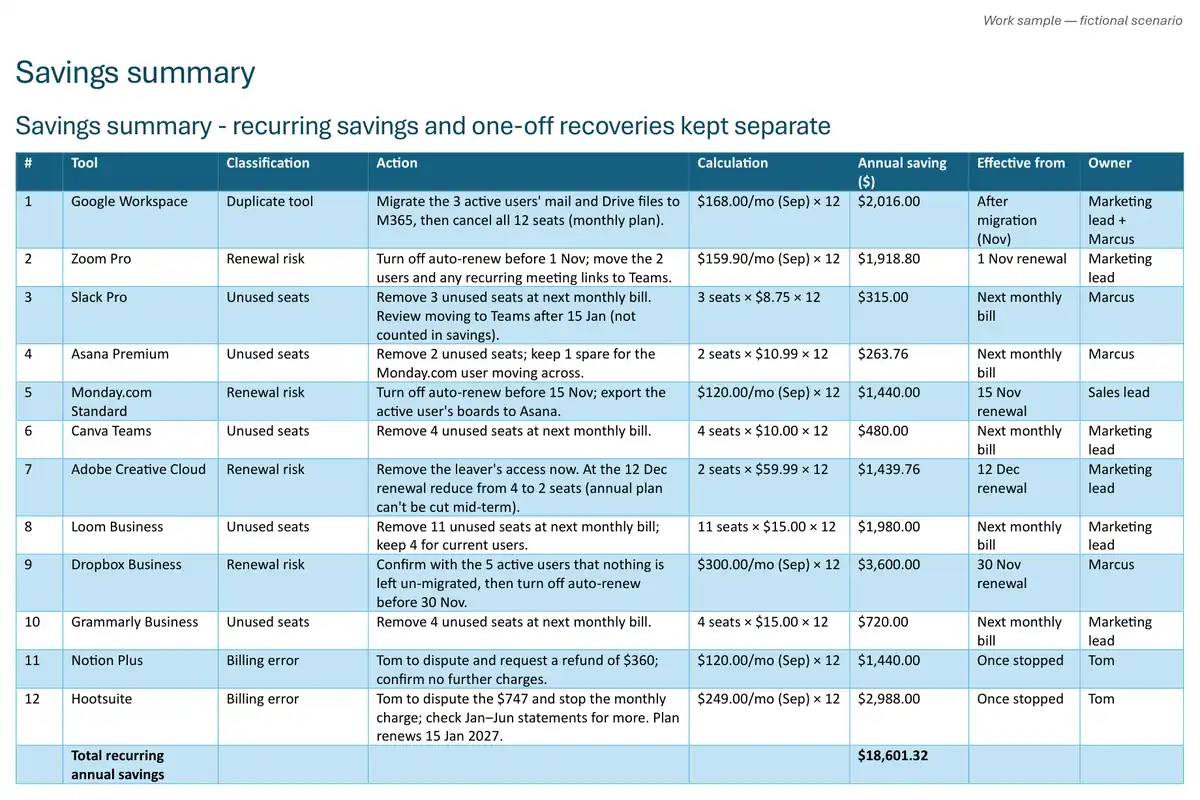
- Reconciled the total three ways: the recommendations, the analysis column and the classifications all give $18,601.32.
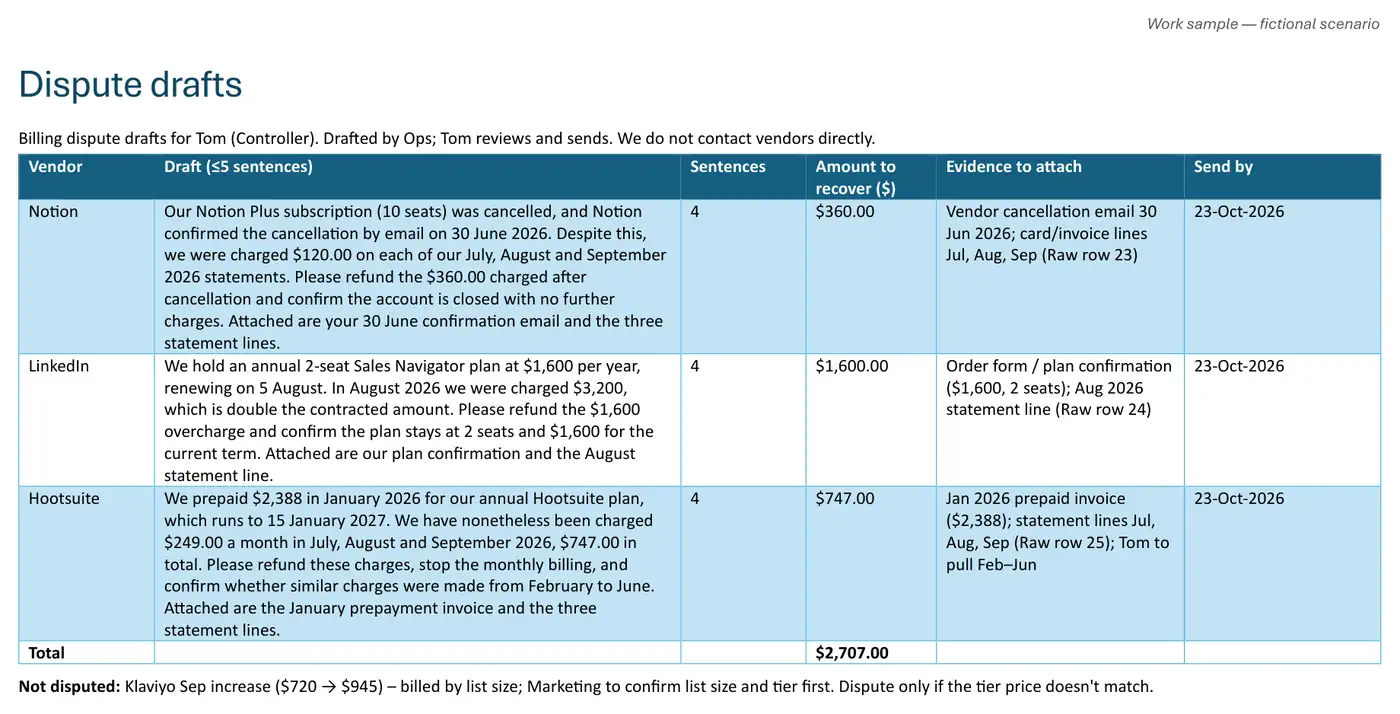
The billing errors were in the Notes column, not the numbers. Notion was still charging $120 a month after the vendor confirmed cancellation, LinkedIn charged $3,200 on a $1,600 plan, and Hootsuite charged monthly on a plan prepaid for the year. Klaviyo’s September rise from $720 to $945 looked like an error but fits its list-size billing, so I flagged it to verify instead of disputing it.
What I delivered
- Memo to Marcus: one page with the total, the top five actions with owners and dates, the billing errors and what I was not cutting.
- Analysis: one row per tool, with metrics, classification and evidence.
- Savings summary: recurring savings and one-off refunds kept separate, with the reconciliation.
- Renewal calendar: the 90 days from Oct 17 to Jan 14, with an action date before each renewal.
- Dispute drafts: three drafts for the Controller to send.
- Log and QA: a three-line log and the checklist result.
What I’d do with more time
Check the Hootsuite statements from February to June, which were not in the export, and confirm Gusto’s billed headcount matches the 85 employees. I’d also revisit Slack after the Jan 15 freeze, where moving to Teams could save up to $2,835 a year more.
How I used AI
Claude created this practice simulation and reviewed my output. The analysis and recommendations are mine.