Executive support · Work sample: fictional scenario, synthetic data
Plan a two-stop business trip within a $1,600 budget
Flights, hotels and rides checked against a traveler's rules, with a cost table, an itinerary and a fallback plan.
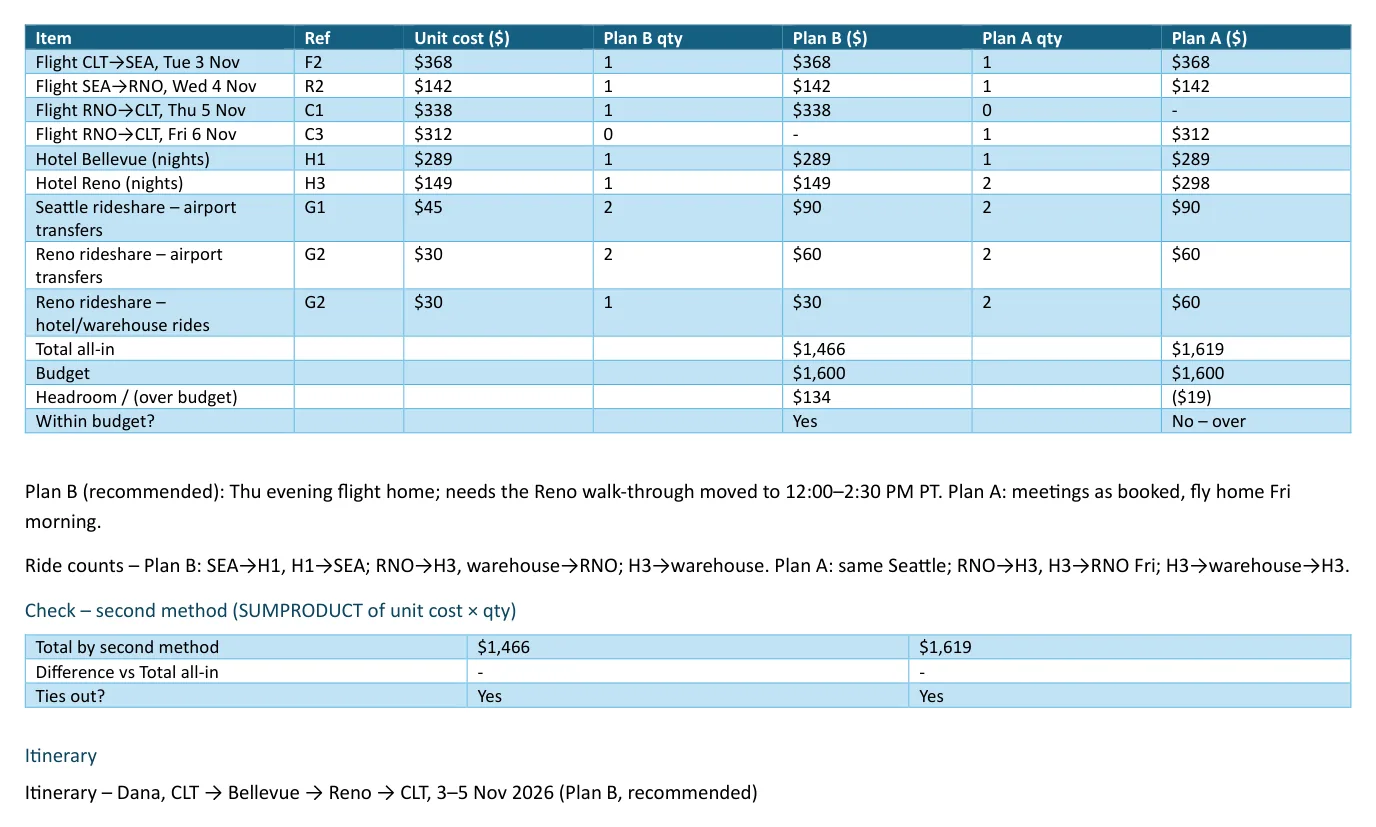
The recommended plan costs $1,466 against a $1,600 budget. The fallback plan is $19 over, at $1,619.
- Time taken
- 75 min (time box)
- Tools
- Excel, Microsoft 365
- AI used
- Claude
- Skills
- Travel planning, Budget trade-offs, Time-zone planning, Contingency planning
- Date
As it arrived
Book whatever makes sense, under $1,600 all-in. I need to be back for my son's school event Friday, Nov 6 at 6:00 PM in Charlotte. Send me the plan and anything I need to decide by Monday noon ET.
Quick look
Deliverables
The details
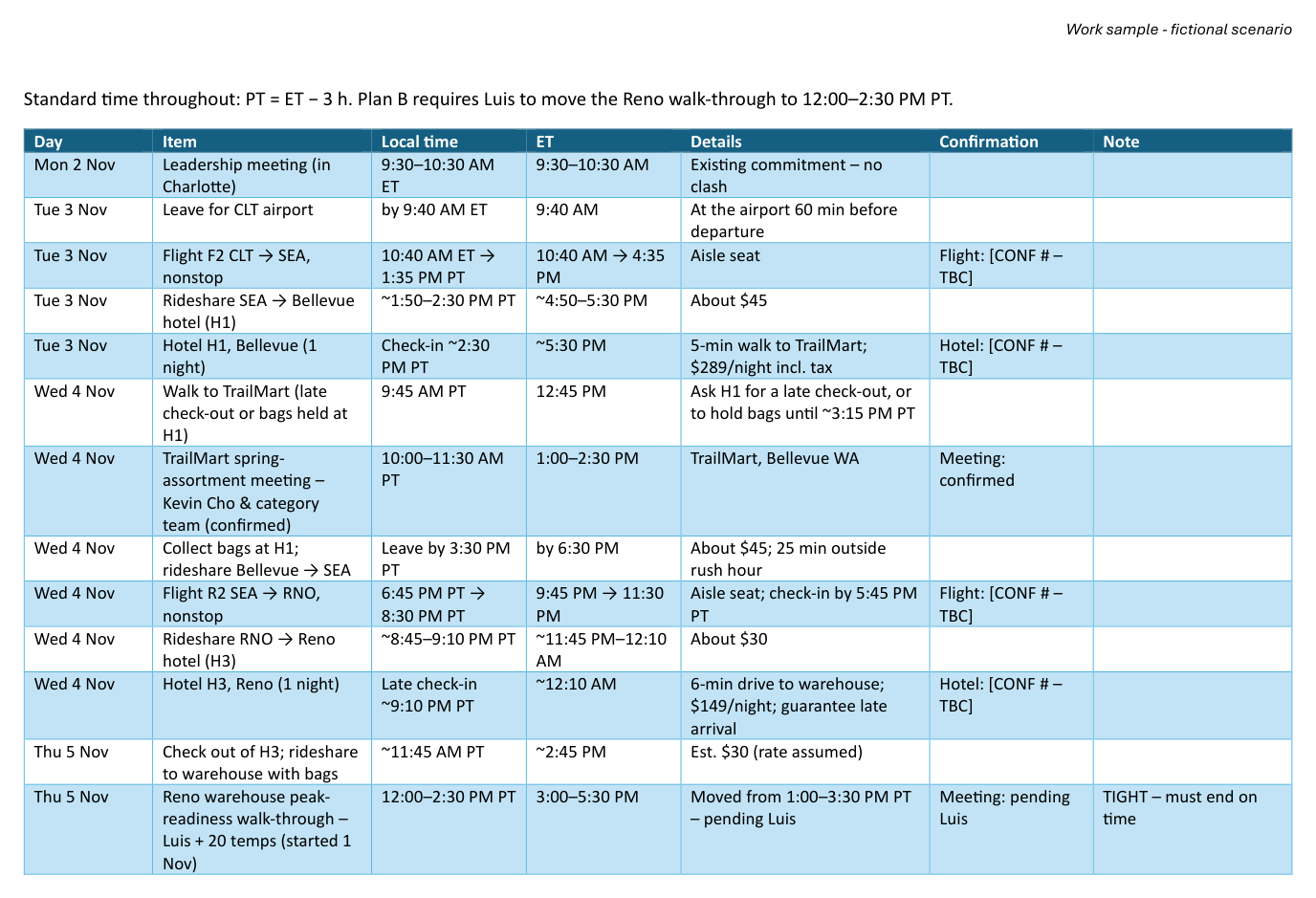
Two stops in the first week of November, leaving from and returning to Charlotte: a spring-assortment meeting with the buyer in Bellevue on Wed, Nov 4, 10:00–11:30 AM PT, and a peak-readiness walk-through at the Reno warehouse on Thu, Nov 5. Home by 6:00 PM on Fri, Nov 6.
The traveler’s rules: no flight before 7:00 AM, no overnight flights, aisle seat only, connections of 60 minutes or more, arrive the day before any external meeting, and a hotel within 15 minutes of the meeting when possible. Budget: $1,600 all-in. Decisions due by Monday noon ET.
My approach
- Listed the traveler’s rules and hard constraints before assessing any option.
- Assessed every flight and hotel option against those rules and recorded the result in a decision log.
- Ran timing tests and checked for clashes with her existing commitments.
- Priced two plans on one cost table and checked the totals a second way. Plan B, recommended, comes to $1,466 and Plan A to $1,619.
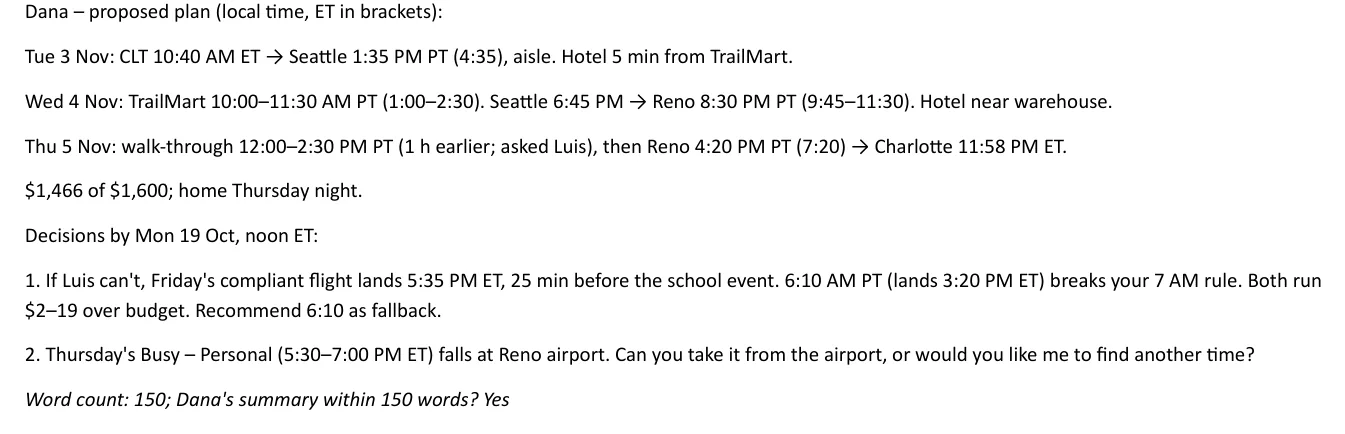
- Wrote the itinerary, a contingency for the most fragile leg, two emails and a summary for the traveler (150 words, two decisions).
- Ran a pre-send checklist on the workbook.
What I delivered
- Decision log: the rules, every option assessed, timing tests and calendar clashes.
- Costs: the cost table against the $1,600 budget.
- Itinerary: the recommended plan, with the fallback if the Reno walk-through cannot move.
- Contingency: the plan for the most fragile leg.
- Messages: emails to the buyer and to the warehouse lead.
- QA run: the pre-send checklist result.
What I’d do with more time
Fill in the seven booking references and the sign-offs, which stay as placeholders because nothing in a practice scenario is booked. I would also export the decision log to PDF at a larger size, since the one-page version is small. The first review caught two real errors (a false reason for rejecting one option, and contradictory Friday times in the fallback plan), so I now run the pre-send checklist before the first review, not after it.
How I used AI
Claude created this practice simulation and reviewed my output. The plan and recommendations are mine.