Operations · Executive support · Work sample: fictional scenario, synthetic data
Write a pre-send QA checklist from the errors in my own work
A 12-check, 5-minute SOP built from the real mistakes in my first three practice samples, with a log to test it.
A 12-check SOP in six groups, each check tied to a real error, run on later samples to catch mistakes before sending.
- Time taken
- 30 min
- Tools
- Word
- AI used
- Claude
- Skills
- Process documentation, Quality assurance, Root-cause analysis
- Date
As it arrived
After three practice samples, six major errors had reached the first review: a wrong meeting time, a summary twice its word limit, a false reason for a rejected option, an out-of-date action table, a placeholder left in, and a budget comparison over mismatched periods. Turn those into a checklist that runs in five minutes before anything is sent.
Quick look
Deliverables
The details
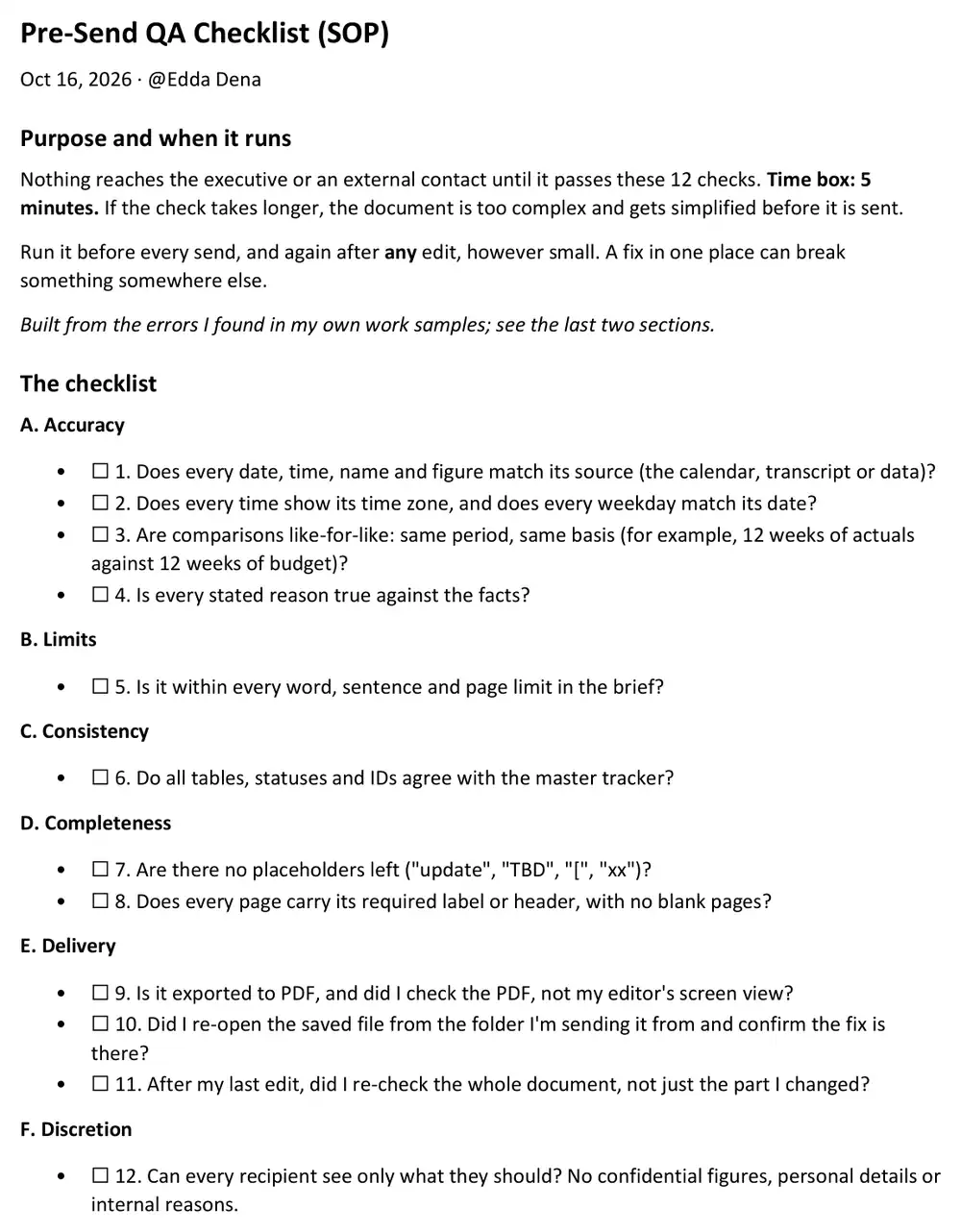
Nothing reaches the executive or an external contact until it passes the checklist. It has to take five minutes or less. If it takes longer, the document is too complex and gets simplified before it goes.
My approach
- Listed every major error that reached the first review in my first three practice samples. A major error is one that would have misled or embarrassed the executive: a wrong fact, a wrong number or a broken limit.
- Grouped them into six: accuracy, limits, consistency, completeness, delivery and discretion.
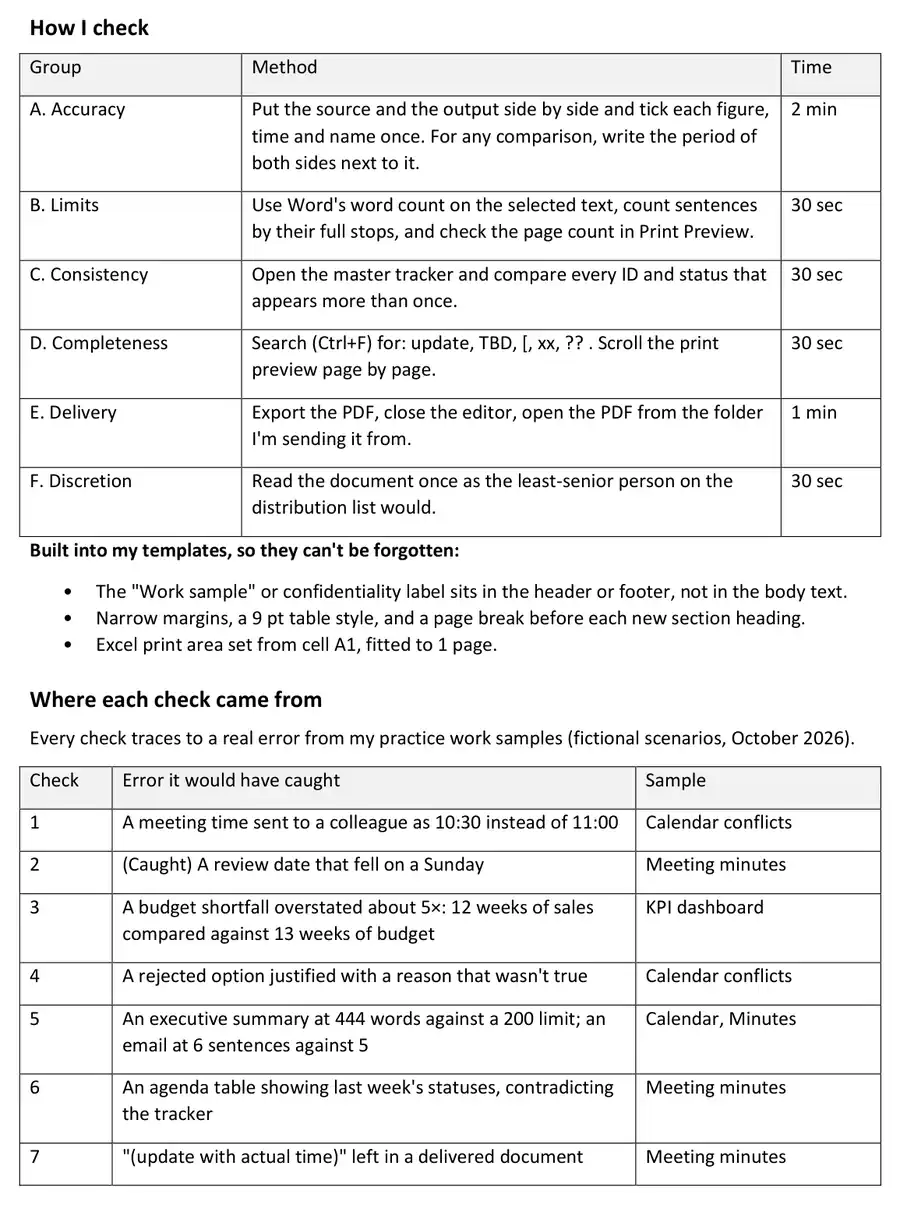
- Wrote one yes-or-no question for each, so every check traces to a real error. For example, check 3 asks whether comparisons are like-for-like, because a budget shortfall was overstated about five times by comparing 12 weeks of sales with 13 weeks of budget.
- Wrote down how each group is checked and how long it takes, so the whole run fits in five minutes.
- Built the fixes into my templates so they can’t be forgotten: the label sits in the page header, tables use a 9 pt style, and Excel print areas start at A1 and fit one page.
- Added a results log, and ran the checklist on the later samples.
The results log showed whether it worked. The first three samples had six major errors between them and no checklist. The checklist was used on the trip plan and the vendor review only after their first review, and it still caught real mistakes: a rejected option described as approved, times with no time zone, and a headline that counted a one-off overcharge as recurring.
What I delivered
- The checklist: 12 checks in six groups, with a five-minute time box.
- How I check: the method and time for each group.
- Where each check came from: the real error and the sample behind every check.
- Results log: errors per sample, and whether the checklist was used. The PDF is the October 16 version. Later results are in the QA tabs of the trip plan and vendor review workbooks.
What I’d do with more time
Run the checklist from the start of a sample, before the first review, and compare the error count with the three samples that had no checklist. That is the real test of whether it works.
How I used AI
Claude created the practice simulations and reviewed my output. The checks, the method and the results log are mine.